
How to list business personal property
Property must be listed each year so that it can be valued (assessed) and taxed. The North Carolina Machinery Act provides the statutes governing the listing of property for property taxation. This guide covers the listing of business personal property.
The NC Department of Revenue has a standard form that can make listing business personal property easier. It can be downloaded from the Department’s website. NC Department of Revenue property tax forms.
When do I file? The listing period begins on January 2 each year. The deadline for listings is January 31. Completed forms must be postmarked by the U.S. Postal Service no later than January 31 to avoid a 10% late list penalty.
Who should list?
Anyone owning property located in a North Carolina county that meets the following criteria:
- Unlicensed automobiles, trucks, trailers, campers, motorcycles and recreational vehicles
- Mobile homes, boats and motors, farm equipment and machinery
- All improvements or changes to leased property
- All business personal property
How do I list?
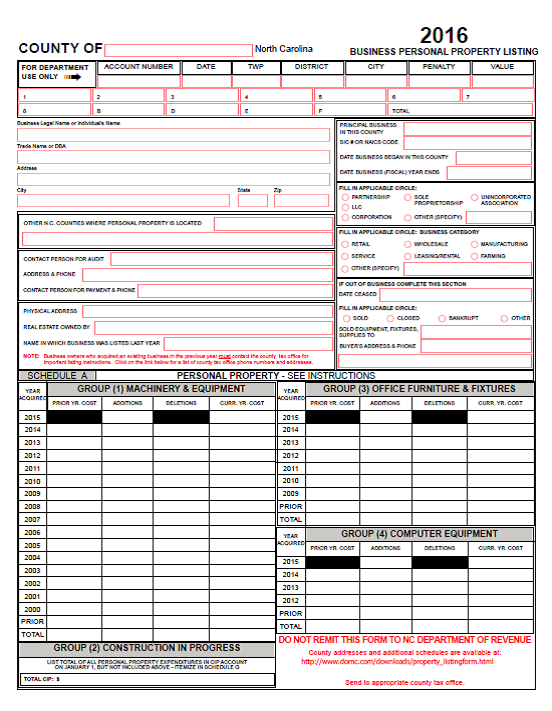
This is where the county listing form or a state-approved listing form is used. Fill out all information at the top of the first page. If something does not apply to you, do not leave it blank; enter “N/A”.
Schedule A
Personal property in the categories of Machinery & Equipment, Furniture & Fixtures, Computer Equipment, Leasehold Improvements, Expensed Items, Construction in Progress, and Supplies should be reported in this section. Fully depreciated assets should also be included.
Capitalized assets are property items expected to have a useful life of more than one year, listed in the Machinery & Equipment, Furniture & Fixtures, Computer Equipment, and Leasehold Improvement groups. Examples:
- Office equipment
- Office decorations
- Desktop computers
- Printers
- Maintenance equipment
- Operating equipment
- Office furniture
- Point of sale equipment
Supplies and expensed items must also be listed. These costs are expensed on your financial records but should still be listed as business personal property. Examples:
- Fuels
- Spare parts
- Office supplies
- Operating expense
- Small tools
- Items used in the process of providing a service
Construction in Progress is the cost you have spent on personal property items still under construction on January 1 that have not been placed into service. This amount represents your investment in the property and is to be listed.
Schedule B
This section is for unregistered motor vehicles, multi-year or permanently registered trailers, special bodies on vehicles, and International Registration Plan plated vehicles. Include the year, make and VIN of the vehicle, as well as the cost and year purchased. This section also includes:
- Watercraft and engines
- Mobile homes or mobile offices
- Aircraft
- Vehicles held for short-term rental
Schedule C: Leased equipment
Property in your possession but owned by others should be listed in this section. This includes any personal property that is loaned, leased, or otherwise held and not owned by you. A complete description and the ownership of the property should also be reported.
Operating leases have either no ownership transfer or a significant buyout clause at the end of the lease, and generally do not transfer ownership at the end of the term. They are not financing arrangements. The person in possession of these items is not responsible for the property taxes; the leasing company should report this property to the county.
Capital leases are considered a financing agreement (a loan) and are reportable by the taxpayer in Schedule A. These leases have little or no buyout amount at the end of the lease. Assets purchased under a capital lease are usually capitalized on the taxpayer’s financial records and considered the taxpayer’s property.
Schedules D through J
- Special property
- Farm equipment
- Leased or rented property from exempt owners (church, government, schools, etc.)
- Detail of acquired and disposed assets
- Real estate improvements
- Billboards
- Leased equipment
Filling in each group
Now that you have gone through your list of assets and determined where each item is to be listed, here is how to put the information on the form. Each group or category has a box. The first column of each box is a date, starting with the most current year and descending in order until you reach “prior”. Items reported in each group should be summarized by year of acquisition and cost.
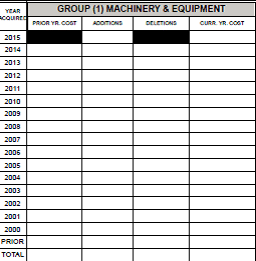
Historical cost should be listed in the original cost column for the year the item was acquired. Historical cost is the amount paid for the item when it was new, along with all costs associated with placing it into operation. If a taxpayer buys a business that is already in operation, the cost of the equipment when it was new should be used, as well as the original in-service date, not the purchase price of the used property.
Any additions or deletions during the year should be listed in the additions/deletions columns. Calculate the current year cost by adding or subtracting the additions and deletions from the original cost, and record it in the current year cost column. Each column should then be totaled.
Why is it important to list?
If all property in a county were correctly listed, appraised and taxed, the tax rate could be significantly lower. Therefore:
- It is essential that every tax program be fair and equitable.
- It is essential that correct information be used in every listing.
- Historical cost needs to be provided, as it is the basis for consistently appraising personal property.
- A review of the taxpayer’s records is essential in order for everyone’s property to be valued correctly.
Questions about your audit?
Call (919) 781-4668 or email info@ctsinc.us. Questions about the taxes you owe go to your county.